What Is Soil CEC? A Guide for Your Lawn Care Plan
You get your soil test back, scan down the page, and see a line that says CEC. Then the questions start.
Is that good or bad? Is it why your lawn burns through fertilizer? Does it mean you need a different product, a different rate, or a different schedule?
If you've been stuck on that one number, you're not alone. CEC sounds technical, but the practical meaning is simple. It tells you how much nutrient-holding capacity your soil has, and that changes how you should fertilize.
By the end of this guide, you'll know what is soil cec, how to read the number on your lab report, and how to turn it into a plan you can use.
Table of Contents
- Your Soil Test Has a CEC Number Now What
- What Is Soil CEC The Nutrient Pantry Analogy
- Why CEC Matters for Your Lawn's Health and Your Wallet
- How to Read Soil CEC on Your Lab Report
- The Action Plan How CEC Changes Your Fertilizer Strategy
- See It in Action How MySoilPlan Uses CEC
- Frequently Asked Questions About Soil CEC
Your Soil Test Has a CEC Number Now What
A lot of homeowners know how to react to low pH or low potassium. CEC is different. It looks important, but most lab reports don't tell you what to do with it.
Say your report shows potassium is low and CEC is low too. Many people focus only on the potassium part and miss the bigger issue. The lawn may need potassium, but the way you apply it matters just as much as the amount.
That's where CEC becomes useful. It doesn't usually decide whether your lawn needs a nutrient. Your soil test levels handle that. CEC helps you decide how aggressively, how often, and how carefully to apply that nutrient so it stays in the root zone long enough to help.
Practical rule: Think of CEC as a pacing number. It tells you whether your lawn needs small, careful refills or whether the soil can hold a bigger correction.
If you haven't tested yet, start there. A basic lab report is the easiest way to get a real CEC number. This guide on where to get your soil tested can help you pick a good option and understand what to send in.
Once you have the number, the confusion usually clears up fast. A low CEC lawn isn't “bad.” It just needs tighter timing. A high CEC lawn isn't automatically “better.” It just holds nutrients differently and usually changes more slowly.
What Is Soil CEC The Nutrient Pantry Analogy
CEC stands for cation exchange capacity. In practical lawn-care terms, it describes how much room your soil has to hold certain positively charged nutrients until the grass can use them.
To understand that without getting lost in chemistry, the pantry comparison helps.
What CEC means in plain English
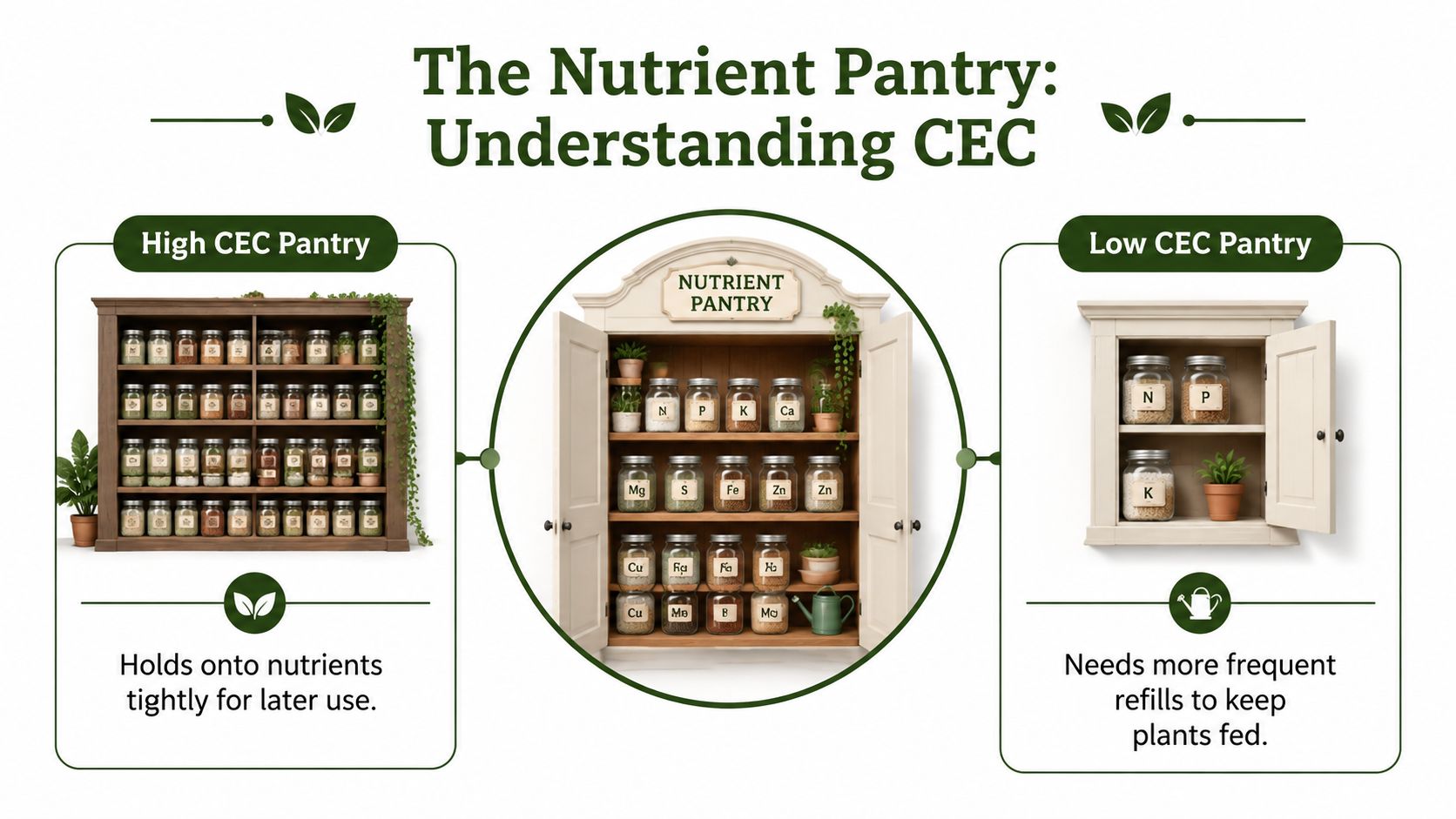
Your soil works like a nutrient pantry.
Some soils have a small pantry with limited shelf space. Others have a larger pantry that can hold more supplies between feedings. The nutrients involved are mostly positively charged ones such as calcium, magnesium, potassium, and hydrogen. Those nutrients need places to sit in the soil instead of washing through too quickly.
So when you see a CEC number on a lab report, read it as a storage-capacity clue. It helps explain how much your soil can hang onto at one time and, just as important, how carefully you need to pace applications.
- Low CEC soil has a small pantry. It fills up fast.
- High CEC soil has a larger pantry. It can hold more before you need another refill.
Why the pantry analogy helps
Say you bring home a month of groceries.
If your pantry is tiny, you do not shop the same way. You buy smaller amounts more often because there is nowhere to put a big load all at once. Soil CEC works the same way with nutrients. A low CEC soil often does better with lighter, timed applications because there are fewer holding spots available in the root zone.
A larger pantry changes the strategy. You still buy what the household needs, but you have more room to store it without crowding everything out. Higher CEC soil gives you more flexibility and usually more staying power from each application.
That is the part many lawn guides skip. CEC does not just help explain what your soil can hold. It changes how you deliver nutrients. Small pantry soil calls for careful refills. Large pantry soil can usually handle bigger refills with less risk of waste.
Soil texture is a big reason CEC varies. Sandy soils usually have fewer holding sites. Soils with more clay or organic matter usually have more. That is why one lawn burns through a fertilizer application quickly while another seems to coast longer on the same treatment.
The gas tank comparison helps here too. The pantry tells you how much storage room the soil has for key nutrients. The gas tank idea points to pacing. A small tank needs more frequent fill-ups. A larger tank lets you go longer between stops. Put those two ideas together and the CEC number starts to become useful instead of abstract.
One detail trips up a lot of homeowners. CEC does not tell you whether the pantry is full. Your nutrient levels handle that part. CEC tells you the pantry size, which is why two lawns with the same low potassium result may need different application schedules.
Why CEC Matters for Your Lawn's Health and Your Wallet
If you've ever fertilized, watered, and then felt like the lawn used up the benefit too fast, CEC is one of the first things to check. It affects how long nutrients stay available, how stable your soil chemistry is, and how much waste you risk with each application.
It changes how much fertilizer stays put
Low CEC soils don't hang on to cation nutrients very well. That's especially important for potassium.
According to Purdue's CEC guide, the CEC of a soil is the sum of its base cations and acid cations, and it reflects the soil's capacity to buffer against nutrient depletion. That same guide notes that turfgrass health is optimized when percent base saturation is 60–80%, and that below 50% can lead to aluminum toxicity in acidic soils with pH below 5.5.
You don't need to calculate all of that by hand for routine lawn care. What matters is the practical meaning. A soil with more holding capacity is better at keeping those nutrients available between applications.
It affects pH stability too
CEC also relates to buffering, which is just the soil's resistance to sudden change. Higher CEC soils tend to resist fast pH swings. Lower CEC soils tend to shift faster.
That's why lime strategy changes with CEC:
- Low CEC soils: pH can move faster, so use smaller, more careful lime corrections.
- High CEC soils: pH usually takes more amendment to change, and the response can be slower.
A high CEC lawn often feels more forgiving. A low CEC lawn usually rewards precision.
This is one place homeowners get tripped up. They expect the same lime rate or fertilizer pattern to work in every yard. It doesn't. Two lawns can both have low potassium, but the better correction plan may look very different if one soil is sandy and the other is a heavier loam.
It helps you waste less
CEC can save you money because it helps you stop overloading the soil at one time.
If your lawn has limited holding capacity, one big fertilizer application may be less efficient than two smaller ones. That doesn't necessarily mean buying more product. It means using the same nutrient correction with better pacing.
A useful mindset is this:
| What the soil test tells you | What CEC tells you |
|---|---|
| What is low | How fast to correct it |
| What is sufficient | How much risk comes with a large application |
| Whether pH needs work | How cautiously to adjust it |
That shift is where CEC becomes practical. You're no longer staring at a mysterious acronym. You're deciding how to feed the lawn without wasting product or pushing nutrients past the root zone.
How to Read Soil CEC on Your Lab Report
You open your soil test, see CEC: 8.5 meq/100g, and the first question is usually simple: “Is that good or bad?”
The better question is, “How should I fertilize a lawn with that kind of soil?” That is the practical use of CEC.
Most labs show CEC as one number, usually in meq/100g. Some reports spell out the unit. Some shorten it and just list CEC 8 or CEC 12. Either way, you are looking at a measure of holding capacity.
The pantry analogy helps here. CEC works like the size of your soil's nutrient pantry. A small pantry cannot store many groceries at once, so overbuying creates waste. A larger pantry can hold more, but filling and changing it takes more time.
What the number means at a glance
You do not need to memorize chemistry to use the number well. Start with a simple reading guide:
| CEC Value (meq/100g) | What it usually means for a homeowner | Common soil tendency |
|---|---|---|
| 1–5 | Very limited holding capacity | Sandy soil, fast drainage |
| 5–10 | Lower holding capacity | Light soil, nutrients move faster |
| 10–15 | Middle range | Loam, more balanced behavior |
| 15–25 | Higher holding capacity | Clay loam or soil with more organic matter |
| 25+ | Very high holding capacity | Heavy clay or very high organic matter |
Those ranges are best used as a handling guide, not a score.
A low number does not mean your soil is “bad.” It means your timing matters more. A high number does not mean your lawn is automatically well-fed. It means the soil can store more, but you still have to check whether the pantry contains enough calcium, magnesium, potassium, and the other nutrients on the report.
How to read your number without overthinking it
Here is the plain-English version I use with homeowners:
- CEC 1 to 5: treat the soil like a small pantry. Use lighter, more frequent nutrient applications.
- CEC 5 to 10: still somewhat limited. Avoid the urge to dump a season's worth of product at once.
- CEC 10 to 15: more flexible. This range usually gives you room for standard application timing.
- CEC 15 to 25: the soil can hold more nutrients, but changes often happen more gradually.
- CEC 25+: expect slower shifts. Big soils often need patience as much as product.
That pacing piece is what many lawn guides skip. Your nutrient levels tell you what is low. CEC helps you decide how fast to correct it.
For example, if two lawns both need more potassium, the lawn with a CEC of 4 usually benefits from smaller split applications. The lawn with a CEC of 18 can often handle a broader correction window. Same nutrient problem. Different delivery strategy.
Read CEC like a feeding-speed guide, not a grade on the report card.
What to do next after you find the CEC number
Once you spot the CEC, look back at the nutrients that are low and ask one practical question: Should I correct this all at once, or in smaller passes?
That is where the number becomes useful.
If your CEC is on the low side, stay measured. Smaller applications are often safer and more efficient because the soil has less reserve space. If your CEC is higher, the soil usually gives you more room to work with, but corrections may take longer to show up clearly on future tests.
If you want a broader walkthrough on pacing applications through the season, this guide on the best way to fertilize a lawn pairs well with your soil report.
One last point that clears up a common misunderstanding. CEC does not replace the rest of the test. It helps you interpret it. The nutrient values tell you what is missing. CEC tells you how gently or aggressively to make the correction.
The Action Plan How CEC Changes Your Fertilizer Strategy
You get your soil test back, see a low nutrient level, and the first instinct is to fix it fast. CEC is the number that helps you slow down and choose the right pace.
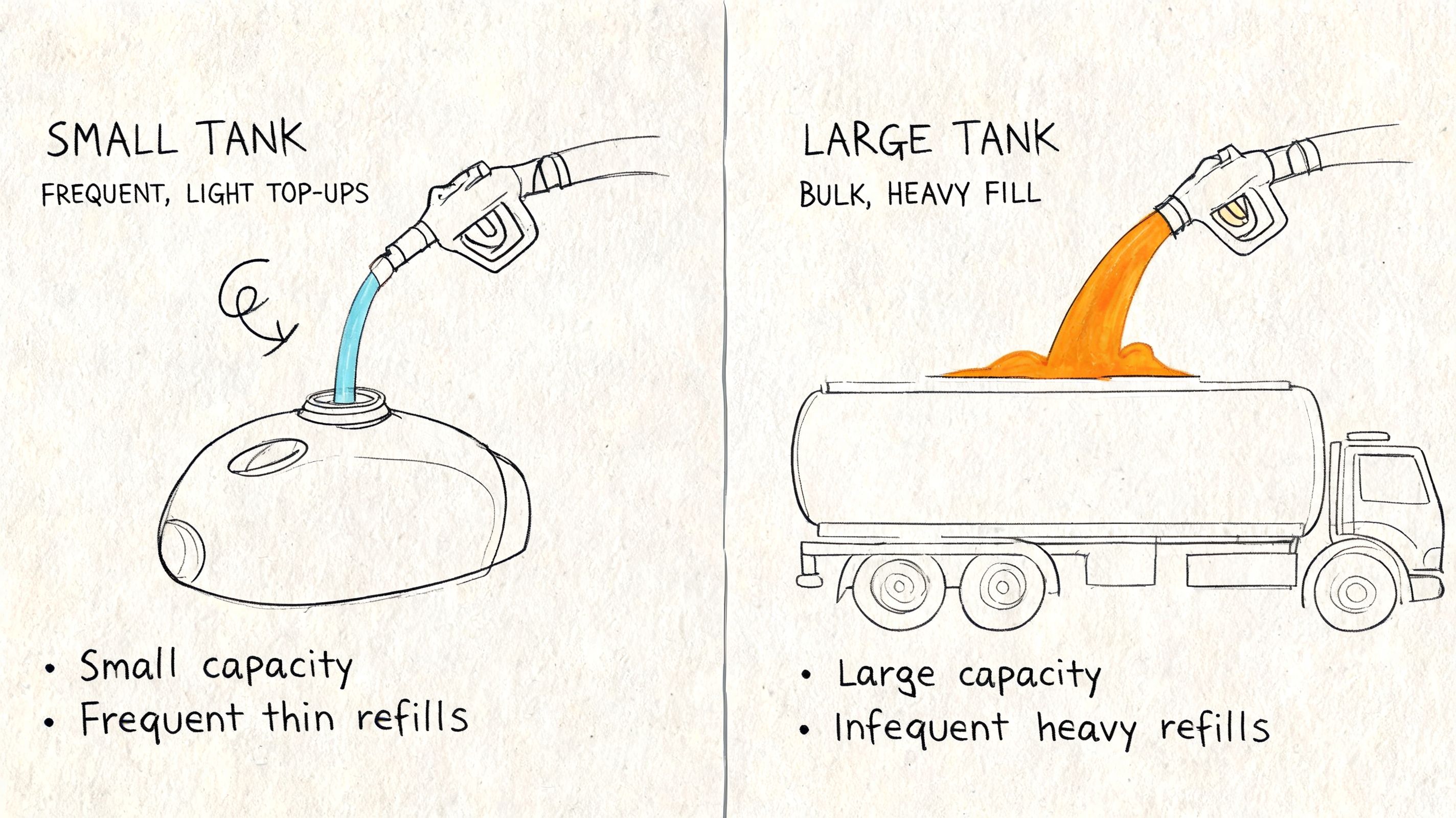
Your pantry analogy explains what the soil can store. A gas tank helps with the next question, which is how to refill it. A small tank needs lighter, more frequent fill-ups. A larger tank gives you more room per stop, but it also takes longer to show a big change.
Low CEC soil behaves like that smaller tank. It cannot hold as much at one time, so big applications are more likely to move past the root zone before the lawn uses them. Higher CEC soil has more holding capacity, which gives you more flexibility on dose size and timing.
If your CEC is low
This usually shows up in sandy or lighter soils, where nutrients do not stick around as well. AgroLiquid notes that sandy soils with a low CEC of 3 to 5 meq/100g can lose a large share of applied potassium within weeks, while soils with higher CEC and more organic matter tend to retain far more of those cation nutrients.
That changes the plan right away.
For low CEC, use this playbook:
- Nitrogen: use split applications, and choose slower-release forms when they fit your program.
- Potassium: break corrections into smaller doses instead of making one heavy application.
- Lime: make conservative adjustments, then retest before adding another large amount.
- Magnesium and calcium products: stay cautious with one-time corrections unless the soil test clearly supports them.
- Watering: avoid heavy irrigation right after fertilizing, because that raises leaching risk.
A good homeowner rule is to spoon-feed low CEC soil. The lawn can still improve well. It just responds better to steadier pacing.
If your CEC is moderate to high
These soils usually give you a bigger pantry and a bigger tank. They can hold cation nutrients more effectively, so you often have more flexibility with correction size.
That does not mean applying fertilizer carelessly. It means the soil can usually handle broader spacing between applications, especially for nutrients like potassium, calcium, and magnesium. The tradeoff is speed. Bigger, heavier soils often change more gradually, so patience matters.
Use this approach:
- Potassium corrections: these can often be handled in fewer applications than on very sandy soil.
- Lime: expect pH adjustments to need more material and more time before the full effect shows up.
- Retesting: give the soil time to respond before judging whether the plan worked.
- Seasonal timing: keep following normal feeding windows and avoid stress periods.
Homeowner shortcut: Low CEC calls for smaller refills more often. Higher CEC usually allows larger refills with a longer response time.
If you want a step-by-step seasonal framework to match that pacing, this guide on the best way to fertilize a lawn is a helpful companion to your soil report.
A simple example
Say your soil test shows:
- CEC: 6
- Potassium: low
A one-shot correction looks efficient on paper, but the soil has limited storage space. In that case, splitting the potassium into separate applications, often in spring and early fall, usually gives the lawn a better chance to use what you apply.
Now change one number:
- CEC: 18
- Potassium: low
The nutrient target stays the same. The delivery plan changes. With a CEC of 18, the soil can usually handle a less cautious correction schedule, so you may not need as many split applications.
That is the practical value of CEC. It helps you choose the pace, dose size, and timing that fit your soil, which is often more useful than the nutrient target by itself.
See It in Action How MySoilPlan Uses CEC
A homeowner example makes this easier.
One lawn two different plans
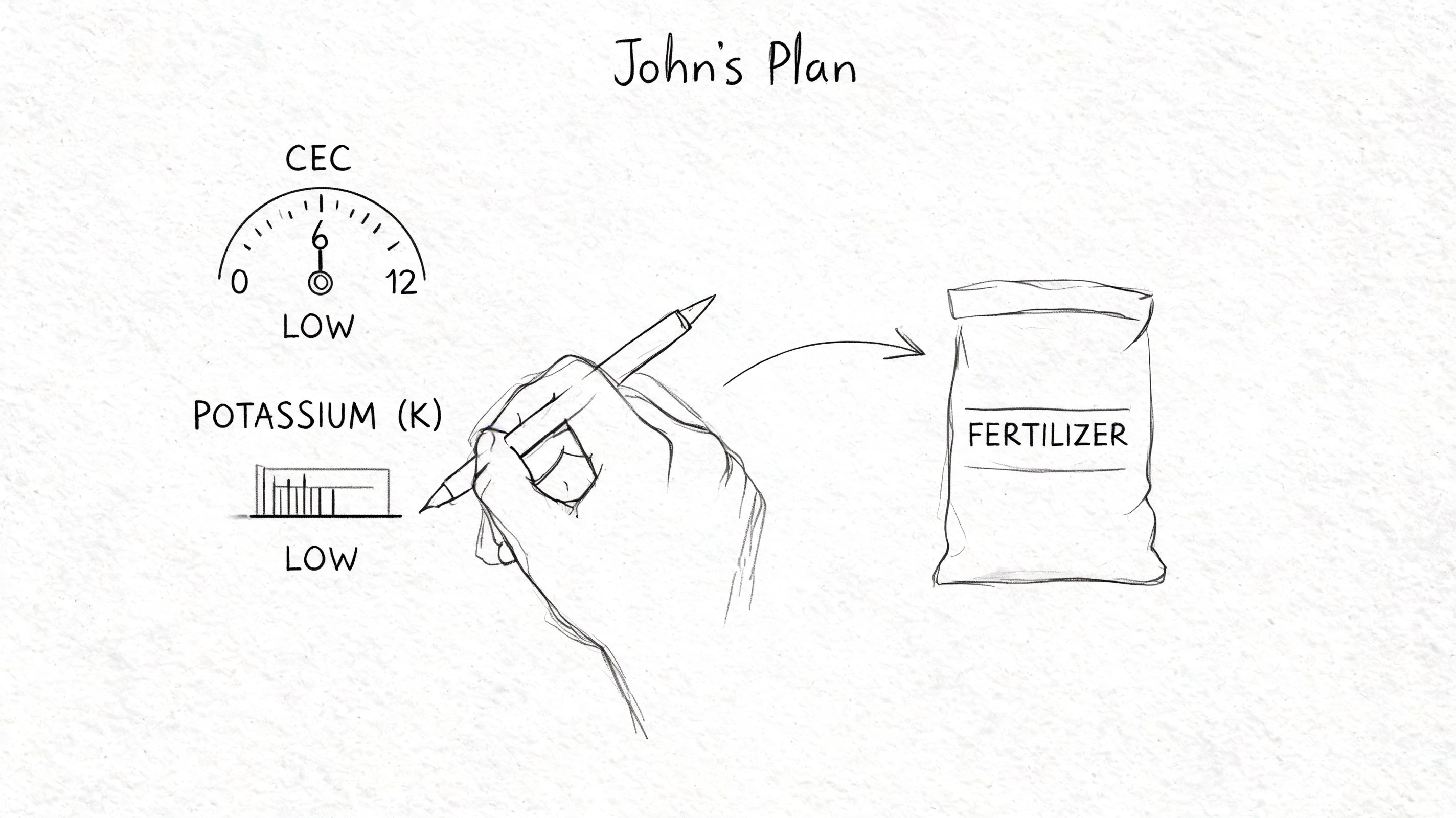
Say John gets a soil test back and sees two clear issues. His potassium is low, and his CEC is 6. A generic plan might only notice the low potassium and tell him to make one correction.
A smarter plan notices the CEC too. Since the soil has low holding capacity, the potassium correction should be split into smaller applications instead of pushed all at once. That lowers the risk that part of the application moves through the soil before the grass can use it.
The same idea applies to pH work. If a lawn has a low CEC, you want to be more careful with lime because lighter soils can shift faster. If you're trying to estimate a safer adjustment, this lime application rate calculator guide is a helpful reference point.
That is the useful part of having CEC in the plan. It helps turn “apply nutrients” into “apply nutrients in a way your soil can handle.”
If you want that logic built into a season-by-season lawn plan, MySoilPlan uses your soil test values, including CEC, to pace nutrient applications more carefully and turn lab numbers into a schedule you can follow.
Frequently Asked Questions About Soil CEC
Is low CEC bad
Low CEC usually means your soil is lighter and cannot hold as many nutrients at one time. That sounds negative at first, but in lawn care it is really a pacing clue.
A low CEC lawn often responds well to a pantry-and-gas-tank approach. The nutrient pantry is smaller, and the gas tank is smaller too, so you refill it in smaller amounts and a little more often. That helps you keep nutrients available to the grass instead of loading up the soil all at once.
Can you raise CEC
You can, but usually slowly.
The usual path is adding organic matter over time so the soil has more places to hold nutrients. Consider a newer option: biochar. According to this Soil Quality fact sheet on CEC and biochar, biochar can improve nutrient-holding capacity in some soils.
For many homeowners, though, the first practical move is not trying to change the CEC number fast. It is adjusting the fertilizer plan to match the CEC you have right now. If your lawn is sandy and hard to keep fed, strategy usually matters before perfection does.
Does CEC affect nitrogen too
Yes, in day-to-day lawn care.
CEC mainly refers to positively charged nutrients like potassium, calcium, and magnesium. But the same soils with low CEC also tend to need more careful feeding overall. If the pantry is small, you usually do better with smaller nitrogen applications and better timing instead of one heavy shot.
That is why CEC changes the how, not just the what.
- Low CEC: smaller doses, more frequent applications, gentler pH and nutrient corrections
- Moderate CEC: standard application pacing usually works well
- High CEC: soil holds more, changes happen more slowly, larger corrections still need patience
A simple way to remember it: low CEC soil works like a small gas tank. Fill it steadily, not all at once.
The CEC number on your soil test helps you choose pace. Once you read it that way, fertilizer decisions get much easier.