How to Lower Soil pH: A Lawn Owner's Guide
You get a soil test back, see a pH in the high 7s or low 8s, and then hit the same wall most homeowners hit. You know “high pH” isn't ideal, but you don't know what to buy, how much to spread, or how to avoid making things worse.
That's where most bad advice starts. Someone says to dump sulfur on the lawn, someone else says use vinegar, and somebody online promises a fast fix. Established turf doesn't work that way.
If you want to learn how to lower soil ph safely, the right approach is simple: confirm the problem, use the right product, apply a conservative amount, and re-test before doing more. Small corrections beat big mistakes every time.
Table of Contents
- What a High Soil pH Really Means for Your Lawn
- Choosing the Right Product to Lower Soil pH
- The Safe Step-by-Step Plan for Applying Sulfur
- How Long It Takes and How to Track Progress
- Troubleshooting Common pH Lowering Issues
- When to Let a Tool Like MySoilPlan Do the Math
- Frequently Asked Questions
What a High Soil pH Really Means for Your Lawn
A high soil pH means your soil is on the alkaline side. For most homeowners, that number shows up on a lab report before anything else makes sense. The important part is this: pH is not a grade. It's a balance point that affects how easily your grass can use nutrients already in the soil.
When pH stays high, the lawn can struggle even when you've fertilized. The nutrients may be present, but the grass can't access them efficiently. That's why a lawn can look pale, thin, or uneven even when you feel like you're feeding it properly.
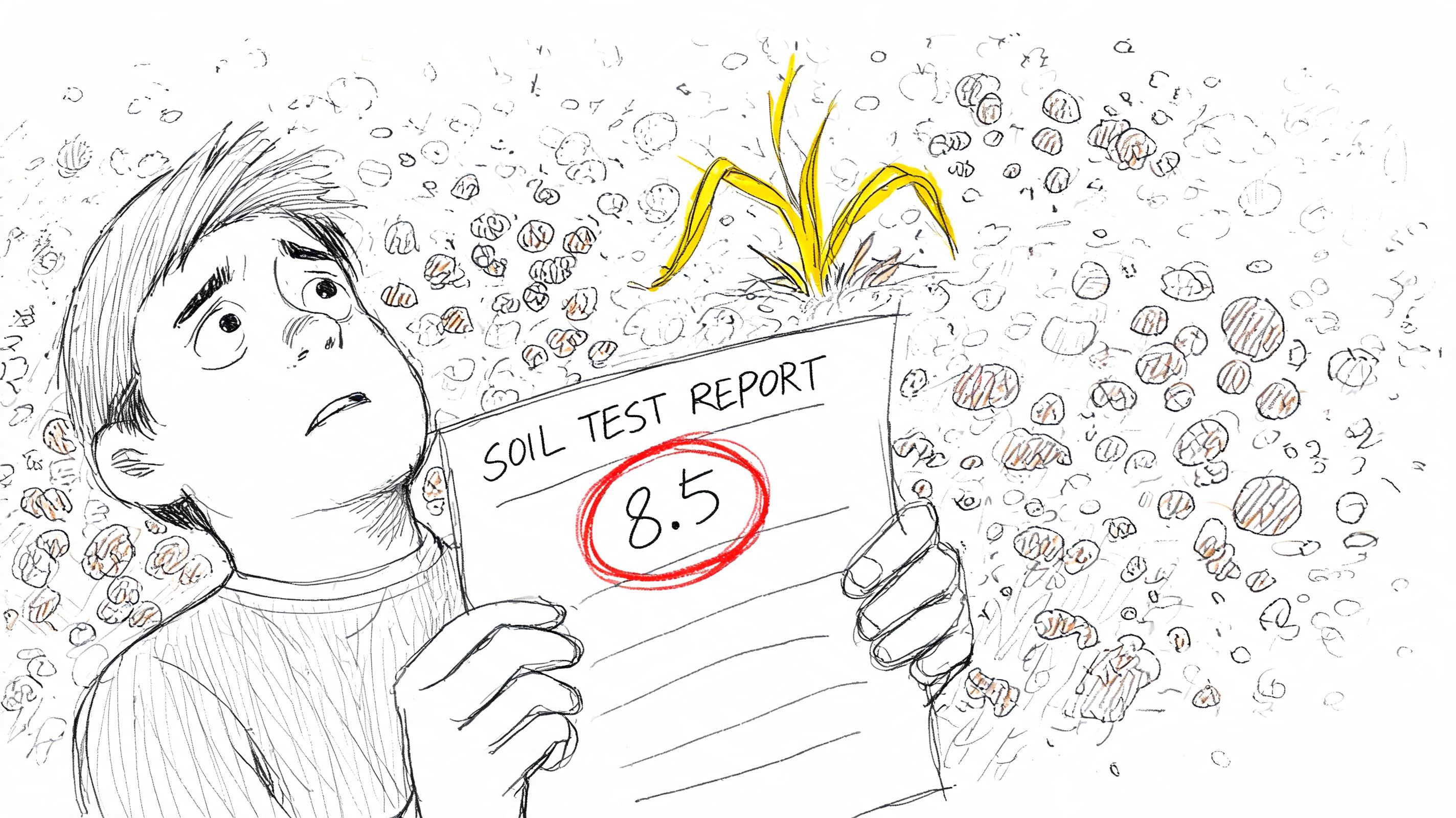
Why pH matters more than most homeowners think
Think of pH like a door lock. Your fertilizer is the key, but if the lock is jammed, the key still won't open the door. High pH can “lock up” nutrients, so the lawn doesn't respond the way you expect.
For most turf, the useful target is usually around pH 6.0 to 6.5 when you're trying to improve nutrient availability through acidification guidance already noted in the verified data. That doesn't mean every lawn over 7 needs treatment. It means you need to compare the pH result with how the lawn is performing.
Don't lower pH just because the number looks high. Lower it when the soil test and the lawn's performance both point in the same direction.
A lab test is better than guessing. If your report includes soil texture and CEC, keep those numbers. CEC means cation exchange capacity. In plain English, it tells you how strongly the soil holds nutrients and how much it resists change. If that term is unfamiliar, this guide on soil CEC in plain English helps make it easier to read.
Why one lawn changes fast and another barely moves
This is the part homeowners usually miss. Two lawns can have the same pH and need very different sulfur rates.
According to USDA NRCS soil pH guidance, high-clay soils show 2 to 3 times greater resistance to pH drops because of higher buffering capacity, with roughly 1.5 to 2 lbs sulfur per 100 sq ft per pH unit compared with 0.75 to 1 lb for sandy soils. That's why sandy soil changes faster and clay soil seems stubborn.
Here's the simple version:
- Sandy soil moves faster. It usually needs less material.
- Loamy soil sits in the middle. It's often the easiest place to start with standard guidance.
- Clay-heavy soil resists change. It needs more patience and more caution.
- Organic matter can also buffer the soil, which means pH correction can take longer than you hoped.
If you only remember one thing from your soil report, remember this: soil pH is not a one-number problem. Texture and buffering decide how aggressive or cautious you need to be.
Choosing the Right Product to Lower Soil pH
Most homeowners don't need a shelf full of specialty products. They need one good default choice and a clear warning about the options that look faster than they really are.
For established lawns, elemental sulfur is the default recommendation. It's the most practical long-term amendment for actual soil pH reduction. It's widely available, affordable, and safer for turf when you apply it in small, split doses.
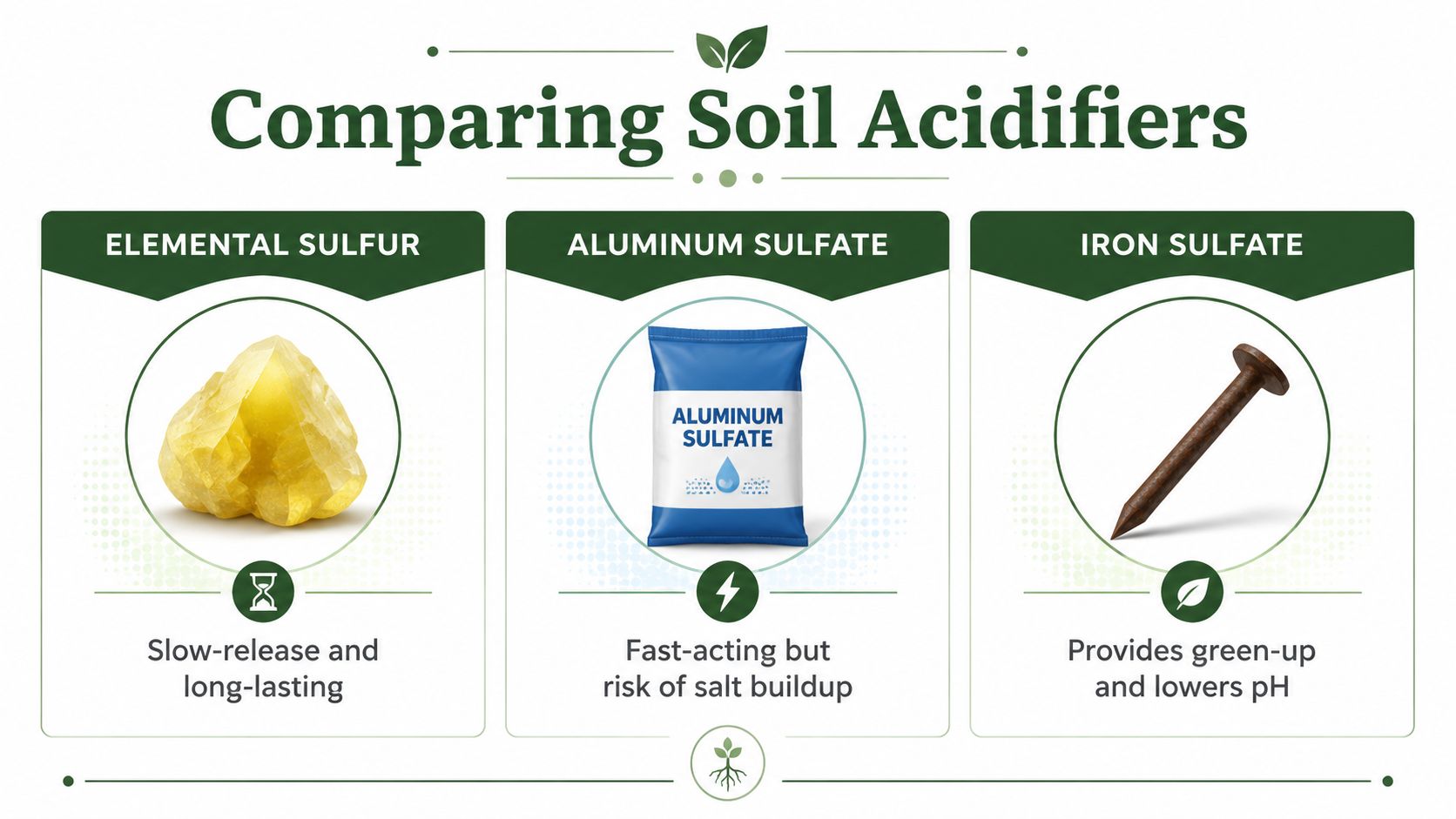
The default choice for lawns
Elemental sulfur works by changing the soil gradually. That's exactly why it's usually the best fit for turf. Lawns reward steady corrections, not shock treatments.
Use it when:
- You want a real pH correction instead of a cosmetic response
- You're working on an established lawn where safety matters more than speed
- You're willing to wait and re-test instead of forcing quick results
If you're shopping in a garden center, this is the product I'd tell a neighbor to start with first.
Products that need extra caution
Some products can lower pH faster, but they come with bigger trade-offs.
| Product | Best use | Main benefit | Main drawback |
|---|---|---|---|
| Elemental sulfur | Established lawns, longer-term correction | Safer long-term choice | Slow |
| Iron sulfate | Small areas, temporary iron response | Faster surface response | Needs more product and can stain hardscapes |
| Aluminum sulfate | Fast pH drop where appropriate | Acts quickly | Higher toxicity risk for lawns |
Aluminum sulfate is the clearest example of “faster isn't always better.” According to Wisconsin horticulture guidance on reducing soil pH, it takes 4 to 6 lb per 100 sq ft to drop pH by 1 unit, acts 6x faster than sulfur, and carries a risk of aluminum toxicity if pH drops below 5.0. That's why it's less recommended for general lawn use.
Bottom line: Use elemental sulfur when you want to change lawn soil pH. Treat faster products as specialist tools, not default solutions.
What about acid-forming fertilizers or organic amendments? They can help maintain direction over time, but they are not a substitute for a real pH correction plan. And if someone tells you to use household acids across a whole lawn, skip it. That's not a dependable strategy.
The Safe Step-by-Step Plan for Applying Sulfur
Established lawns need pacing. Many articles make their mistake at this point. They give you the total theoretical amount, then leave you one bad spreader pass away from burning the turf.
The safer method is to calculate what the soil may need, then cap what you apply at one time.
Start with the target, not the bag
First, confirm that lowering pH makes sense for your lawn. If the turf is performing well and the pH is only slightly high, you may not need to push it hard.
If your soil test shows loam, one useful benchmark is this: guidance on sulfur rates for pH reduction gives 1.2 lb elemental sulfur per 100 sq ft to drop pH by 1 unit in loamy soil. The same guidance also says that on established lawns you should never exceed 5 lbs per 1,000 sq ft in a single application and should wait 2 to 3 months before reapplying.
That cap matters more than the total.
A turf-safe sulfur plan you can follow
Use this sequence for an established lawn:
-
Read the soil test carefully
Look at current pH, soil texture, and anything that suggests the lawn may resist change. -
Set a modest goal
Don't chase a huge drop in one season. A small correction is safer and more realistic. -
Estimate the theoretical amount
Use your soil texture and the lab result. Loam can follow the benchmark above. Clay usually needs more. Sand usually needs less. -
Cap the first application
Even if the math suggests more, don't exceed 5 lbs per 1,000 sq ft in one application on established turf, using the linked rate guidance above. -
Apply in cool conditions
Spread evenly when the lawn isn't heat-stressed. Avoid stacking acidifying products at the same time. -
Water it in
Get the material off the leaf blade and into the soil surface. -
Wait before repeating
Give it 2 to 3 months before another sulfur application on established turf, and only after reassessing the lawn and the timing.
Lowering pH is like steering a slow ship. Small corrections keep you on course. Big corrections are how you overshoot.
A real example for an established lawn
Let's say your lawn is 5,000 sq ft, the soil is loamy, and you're trying to lower pH by 0.5 units.
Using the loam benchmark, a 1-unit drop takes 1.2 lb per 100 sq ft. A 0.5-unit drop is about half that, or 0.6 lb per 100 sq ft. On 5,000 sq ft, that works out to about 30 lbs of elemental sulfur as a theoretical total.
But you still do not dump all 30 lbs at once.
Your turf-safe first application is capped at 5 lbs per 1,000 sq ft, so on 5,000 sq ft your maximum first pass is 25 lbs. Then you wait 2 to 3 months, watch the lawn, and decide whether another small application is justified.
That's what safe pacing looks like in practice.
How Long It Takes and How to Track Progress
The biggest mistake after a sulfur application is impatience. Homeowners spread it, wait two weeks, see no visible change, and then spread more. That's how good intentions turn into damage.
Why sulfur works slowly
Elemental sulfur doesn't change pH the minute it hits the ground. Soil microbes have to convert it first. According to University of Connecticut soil pH guidance, that microbial oxidation process can take 3 to 6 months to show significant pH change, and the full effect can sometimes take up to a year. The same guidance notes that split applications of 0.5 to 1 pound per 100 sq ft monthly are safer and more effective than one large application, especially if the sulfur isn't tilled in.
That timeline explains a lot. In an established lawn, you're working from the surface downward, not mixing the amendment deep into the soil.
What to do while you wait
Track progress with a plan, not with guesses.
- Mark the application date so you don't lose track
- Watch turf response without assuming color alone tells the whole story
- Avoid adding more sulfur too soon
- Re-test the soil before planning the next correction
If you need help figuring out where to send a sample, this guide on where to get your soil tested is a good place to start.
Most sulfur failures aren't true failures. The homeowner either expected a fast reaction or reapplied before the first application had time to work.
A fresh soil test is what turns this from guessing into management.
Troubleshooting Common pH Lowering Issues
Sometimes you do everything right and the pH barely moves. Other times the pH drops too far because the lawn got repeated applications without enough waiting. Both problems are common.
When the pH won't budge
If your lawn sits in a strongly alkaline area, there may be more going on than one high pH number. Some soils contain free calcium carbonate, often called free lime. In those soils, pH reduction can be temporary or impractical because the soil keeps pushing back toward alkaline conditions.
A slower, steadier strategy can help in those situations. According to guidance on natural ways to lower soil pH with organic matter, a 5 to 10% annual increase in organic matter, such as a 1 to 2 inch compost mulch, can lower pH by 0.5 units over 2 years in soils with a pH of 7.8+, while helping buffer against rebound.
That doesn't replace sulfur where sulfur makes sense. It means some lawns need a long game:
- Use compost to build better soil instead of chasing a dramatic one-shot drop
- Accept limits in high-lime soils
- Choose realistic targets instead of forcing the lawn into a range it won't hold
When you pushed too far
Over-acidifying a lawn creates a new set of problems. Grass can thin, nutrient balance can get messy, and you can end up trying to undo your own correction.
If you think you overshot:
- Stop all acidifying products
- Get a new soil test
- Do not guess with lime
- Apply lime only if the new test supports it
- Give the soil time to stabilize before making another correction
If you make the soil too acidic, more fertilizer won't solve the real problem. The pH has to be corrected first.
The best prevention is pacing. Don't stack sulfur, acid-forming fertilizers, and quick-fix products just because the first change felt slow.
When to Let a Tool Like MySoilPlan Do the Math
Lowering lawn pH sounds simple until you try to do the math by hand. Then you realize you're juggling pH, square footage, soil texture, buffering, split applications, and safety caps for established turf.
Why manual math goes wrong
Most homeowner mistakes happen in one of three places:
- They use a generic rate without adjusting for sand, loam, or clay
- They apply the full calculated amount at once
- They repeat too soon because they expect instant results
A decent plan needs to account for more than one number on a soil test. It should pace the work across the season and keep the lawn out of the danger zone.
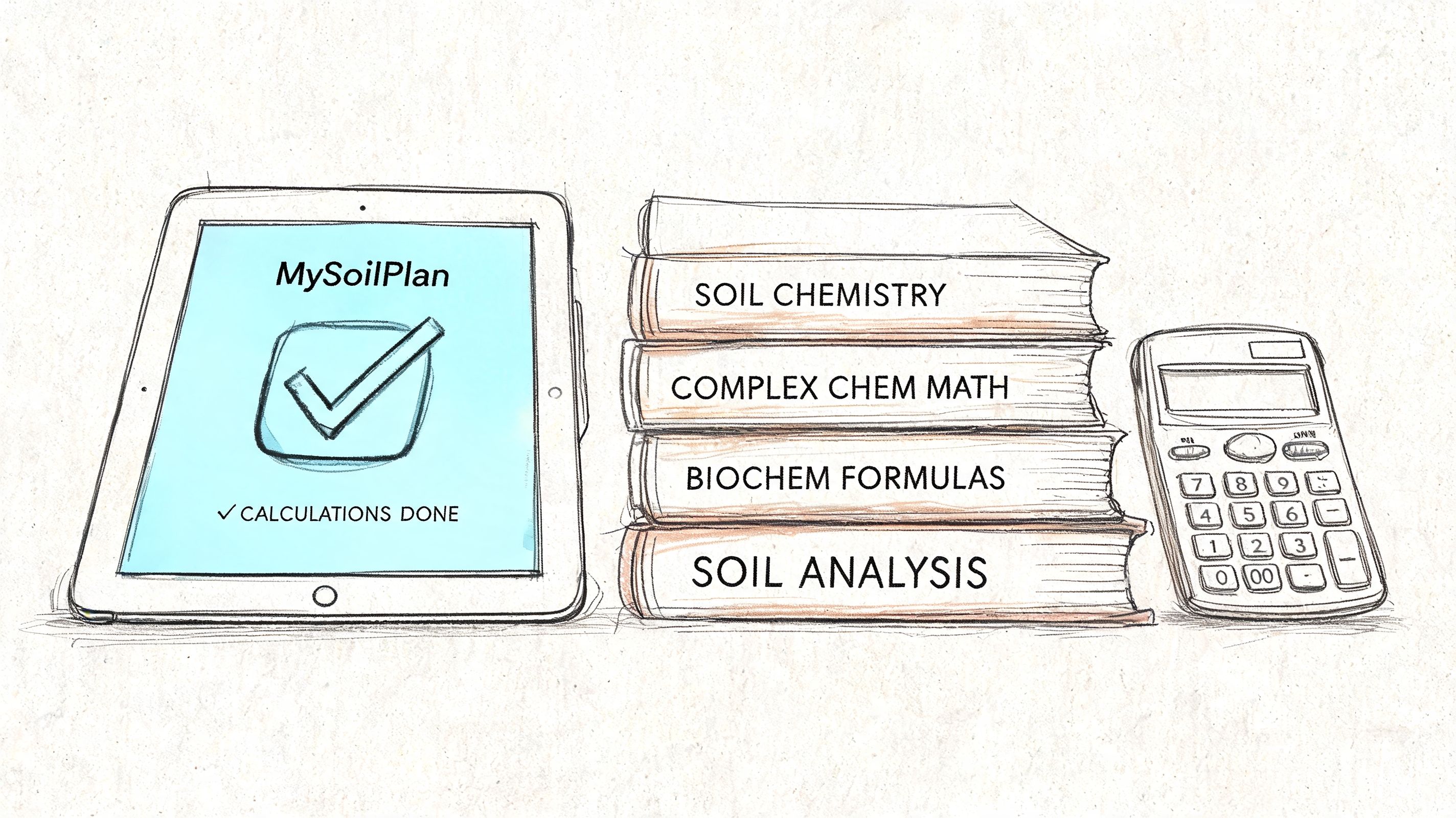
What a planning tool should handle for you
A tool like MySoilPlan makes sense when you want the sulfur math turned into a practical to-do list instead of a spreadsheet problem.
What that kind of tool should do well:
- Read the whole soil test instead of focusing on pH alone
- Adjust rates to soil conditions so clay isn't treated like sand
- Build in safe spacing between applications
- Flag over-application risk before you spread anything
- Keep the plan seasonal so you're not applying products at the wrong time
If you enjoy doing the calculations yourself, that's fine. But for most homeowners, a structured plan is the safer route because it removes the urge to improvise.
Frequently Asked Questions
Can I use vinegar to lower soil pH
For a lawn, no. Vinegar is not a dependable pH management plan for a large soil area. It may create a short-lived surface effect, but that's not the same as a stable correction in the root zone.
Use a real soil amendment instead.
Do coffee grounds fix an alkaline lawn
Not in any meaningful lawn-management sense. Coffee grounds can be part of organic matter recycling, but they are not a practical main tool for lowering pH across established turf.
If your lawn needs a true correction, treat the pH issue directly and use organic matter as support, not as a shortcut.
Will lower pH kill weeds
No. pH management helps grass use nutrients better and can improve overall turf performance. A stronger lawn competes better with weeds, but lowering pH is not a weed killer.
If weeds are the main problem, treat weeds as a separate issue.
Is it easier to lower pH in a garden than a lawn
Usually, yes. In a garden bed, you can mix sulfur or other amendments into the soil before planting. That gives faster, more even contact through the root zone.
Established lawns are slower because you're applying from the surface. That's why the pace has to be more conservative.
Should I lower pH if my lawn looks fine
Not automatically. A high number alone doesn't always justify treatment. If the grass is healthy and the soil test doesn't point to a clear pH-related issue, aggressive correction may create more risk than benefit.
Start with the test result, then compare it to how the lawn is growing.
What's the safest mindset for how to lower soil ph
Start low, go slow, and re-test. That's the whole game.
Small sulfur applications, enough waiting time, and a follow-up soil test will protect your lawn better than any quick fix.
Lowering soil pH safely comes down to restraint. Use elemental sulfur as the default for lawns, respect the single-application cap on established turf, and don't chase instant results. The lawn can recover from a slow plan. It may not recover quickly from an aggressive one.