Your Lawn Care Summer Plan: From Soil Test to Green Grass
Most summer lawn advice overlooks a primary problem. Homeowners worry about whether they should fertilize in hot weather, but the bigger mistake is fertilizing without a watering plan.
That's what burns lawns, feeds disease, and wastes product. In summer, grass is already dealing with heat, dry soil, traffic, and uneven growth. If you throw fertilizer on top of that stress without checking moisture, mowing height, and soil test numbers, you make the lawn work harder when it should be protected.
A good lawn care summer plan is less about pushing growth and more about managing stress. The right moves are simple once you know what your soil is telling you. You need to know when to hold back, when to water first, when to mow higher, and when a small targeted feeding makes sense.
Table of Contents
- The Real Mistake in Summer Lawn Care
- Build a Resilient Lawn for Summer Heat
- Your Summer Mowing and Watering Schedule
- How to Fertilize in Summer Based on a Soil Test
- Create Your Precise Plan with MySoilPlan
- How to Handle Summer Diseases and Pests
The Real Mistake in Summer Lawn Care
Summer damage usually gets blamed on heat. In the yards I see, heat is only the trigger. The bigger problem is poor decisions layered on top of heat, especially mowing too low, watering shallow, and applying fertilizer before checking whether the soil can support growth.
The expensive mistake is treating every tired-looking lawn like it needs food.
A lawn that is slow, dry, and stressed does not use nutrients well. Nitrogen can push blade growth at the exact time roots are short on moisture and oxygen. That is how a summer application meant to green things up turns into more wilt, more disease pressure, and more uneven color a week later.
Practical rule: Water the lawn back to a normal moisture level first. Then decide whether fertilizer still makes sense, apply during a cooler part of the day, and water granular product into the soil.
The part many summer guides skip is the soil test. A lab report keeps you from solving the wrong problem. If potassium is low, the schedule should focus on stress tolerance. If phosphorus is already high, adding more does nothing useful. If pH is off, the lawn may struggle to use nutrients that are already present. Those numbers should shape every summer decision, including how much growth to push and when to hold back.
Good summer care starts with three questions:
- Is the lawn growing, or only hanging on?
- Does the root zone have enough moisture to safely support nutrients?
- What does the soil test say is missing?
Those answers turn summer care into a plan instead of a guess. A lawn with adequate nutrients and weak moisture retention needs different action than a lawn with low potassium and compacted soil. That is why I like pairing lab results with a tool that turns those numbers into a usable schedule. MySoilPlan helps connect test values to practical summer choices, including when to feed lightly, when to skip fertilizer, and when to focus on watering and core aeration timing for compacted lawns.
Summer is not the time for blanket feeding. It is the time for precise choices that reduce stress and protect the root system.
Build a Resilient Lawn for Summer Heat
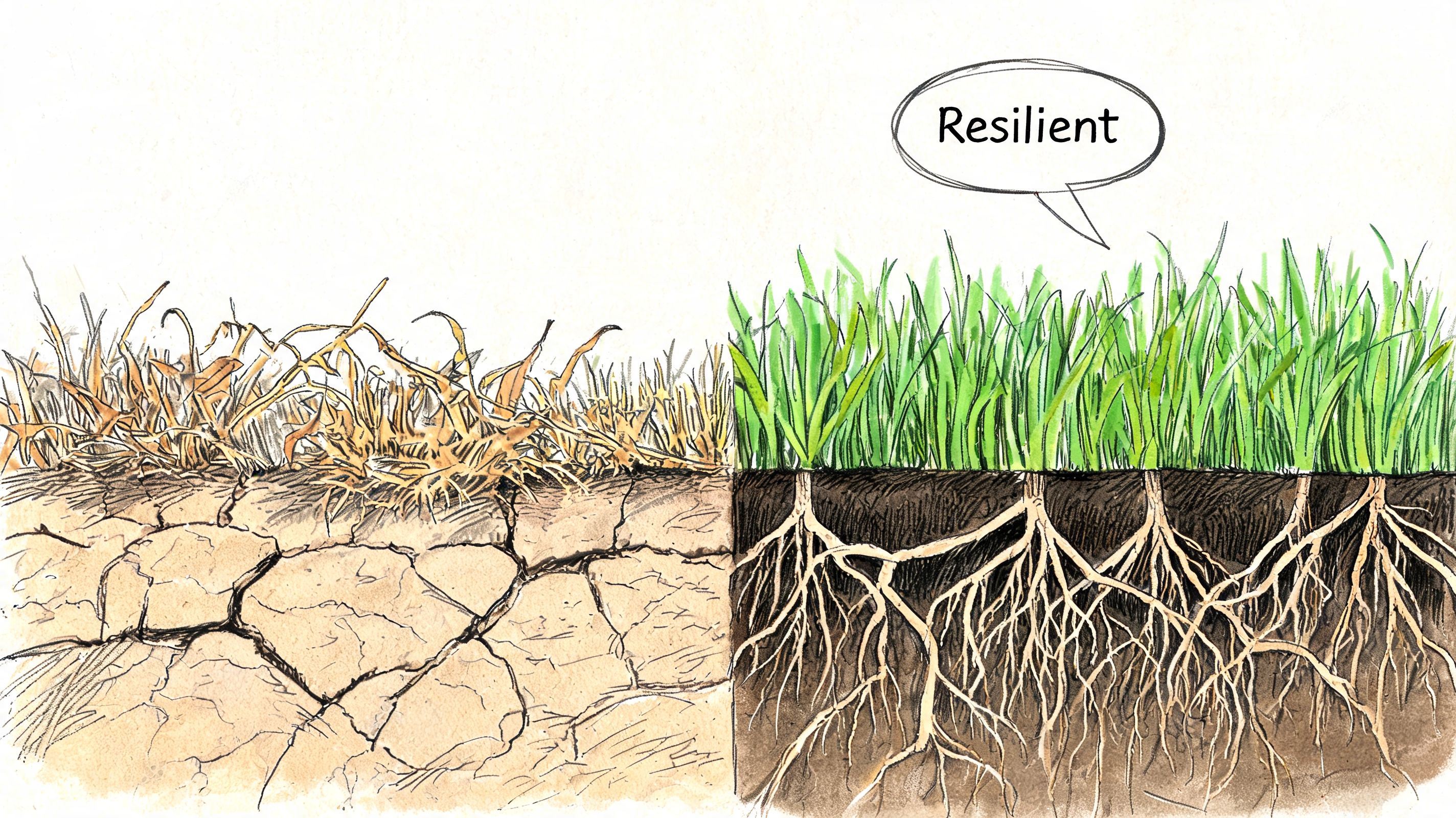
Why summer care is really about stress
A lot of homeowners spend summer trying to make the lawn grow faster. That's the wrong target. In hot weather, the smarter target is resilience.
A resilient lawn handles dry stretches better. It recovers from foot traffic faster. It doesn't swing as hard between dark green flushes and weak, thin patches. In practice, that means you stop asking, “What can I add?” and start asking, “What is making this lawn struggle?”
The first rule is simple. Do not feed a thirsty lawn. If the soil is dry, the turf is heat-stressed, or the grass has slowed way down, fertilizer can sit there at the wrong moment and add stress instead of relief. Water the lawn back to a healthy baseline first. Then decide if feeding still makes sense.
In July, fertilizer works best when the lawn isn't fighting thirst. Apply to a hydrated lawn, avoid the heat of the day, and water granular products into the soil instead of leaving nutrients on the blade.
What resilience looks like in the soil
The part most summer guides skip is the soil itself. Better soil buys you margin in hard weather. That matters more than squeezing out extra top growth.
Recent drought-cycle guidance points to soil organic matter above 4% to 6% as critical for summer survival, and notes that soils with at least 3% organic matter can improve water retention by 20% to 30%, as summarized in this summer lawn guidance. Organic matter is the part of the soil that acts like a sponge. It helps hold water where roots can use it.
If your soil test includes OM or organic matter, use it as a summer decision tool:
- Below 3% OM means the soil dries faster and needs more careful water management.
- Around 3% or higher means the soil has a better buffer against dry periods.
- Above 4% to 6% points to stronger summer resilience.
That doesn't mean you dump fertilizer on the lawn. It means you improve the soil and protect the root zone. Core aeration, compost-based improvement, and less compaction all support that goal. If you need help deciding when to relieve compaction, this guide on how often you should aerate your lawn is a useful next step.
A resilient lawn also follows a different summer rhythm:
- Water before stress gets severe
- Mow in a way that protects the crown
- Feed only when the lawn can use it
- Fix weak soil instead of masking it
That's what works. Chasing fast green-up in summer usually doesn't.
Your Summer Mowing and Watering Schedule
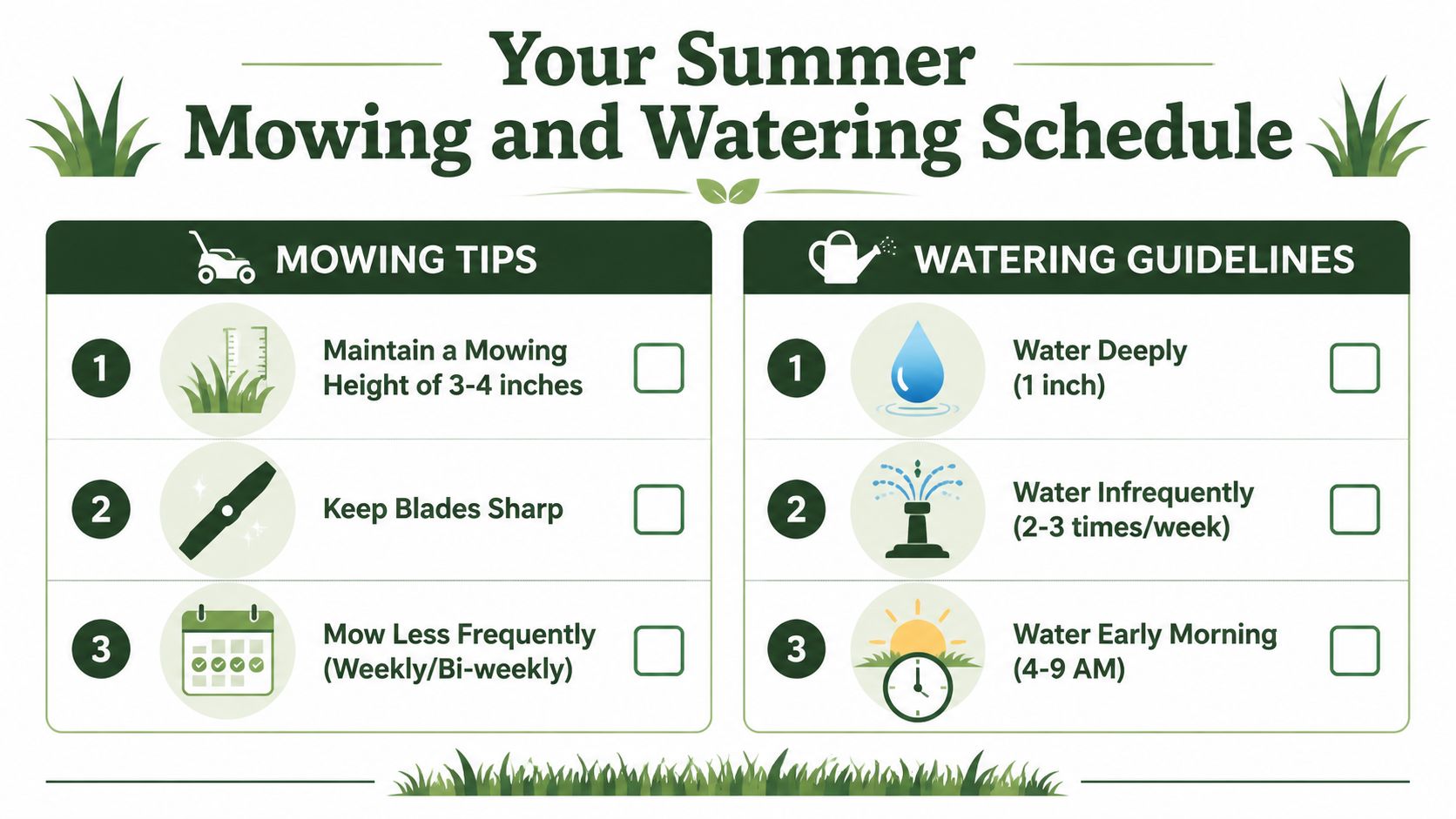
Mow for shade not speed
Summer mowing should protect the lawn, not clean it up too aggressively. For cool-season grasses, raise the mower to 3 to 3.5 inches in summer. Proper mowing at that height is linked to 40% to 50% deeper roots and can reduce crabgrass invasion by 60%, according to Iowa State guidance summarized here.
That height matters because taller grass shades the soil. Shaded soil loses less moisture, and the plant crown stays under less heat stress. Short mowing does the opposite. It exposes the crown, dries the surface faster, and turns every hot afternoon into a harder recovery cycle.
Use this mowing checklist:
- Raise the deck: Keep cool-season grass in the 3 to 3.5 inch range during summer.
- Follow the one-third rule: Never remove more than one-third of the blade in one mowing.
- Keep blades sharp: Clean cuts lose less moisture than torn grass.
- Leave clippings when practical: Clippings return nutrients and help the lawn without another product pass.
If the lawn gets ahead of you, don't scalp it back in one cut. Bring it down gradually over multiple mowings.
Water to soak the root zone
Most lawns are watered too lightly and too often. That keeps the surface damp and the roots shallow. A better lawn care summer pattern is deep, early watering.
Authoritative summer guidance recommends at least 1 inch of water per week, applied in the early morning, as noted in these summer care recommendations. Early watering reduces evaporation and gives the leaf surface time to dry. That matters because many summer disease problems get worse when grass stays wet overnight.
Here's the schedule I trust most for homeowners:
| Task | What to do | Why it works |
|---|---|---|
| Weekly watering target | Apply about 1 inch total across the week | Encourages deeper rooting |
| Timing | Water early morning | Less evaporation, less overnight leaf wetness |
| Frequency | Split into one or two deeper sessions if needed | Better than daily light sprinkling |
| Before granular fertilizer | Make sure the lawn isn't drought-dry | Lowers stress at application time |
| After granular fertilizer | Water it in | Moves nutrients off the blade and into the soil |
One pattern causes a lot of avoidable trouble: evening irrigation in the same wet spot over and over. The grass stays damp too long, airflow is poorer overnight, and fungal issues tend to settle into those repeat locations.
Water the lawn early enough that the blades dry the same day. That one timing change solves a lot of summer disease pressure.
If you're unsure how to judge your watering schedule, this guide on how often to water grass for a greener lawn can help you tighten it up.
A simple weekly routine works well:
- Check soil moisture and forecast.
- Water thoroughly in the morning if the lawn needs it.
- Mow only when the grass is dry enough for a clean cut.
- Delay fertilizer if the lawn is dull, wilted, or heat-stressed.
That routine is boring. It also works.
How to Fertilize in Summer Based on a Soil Test
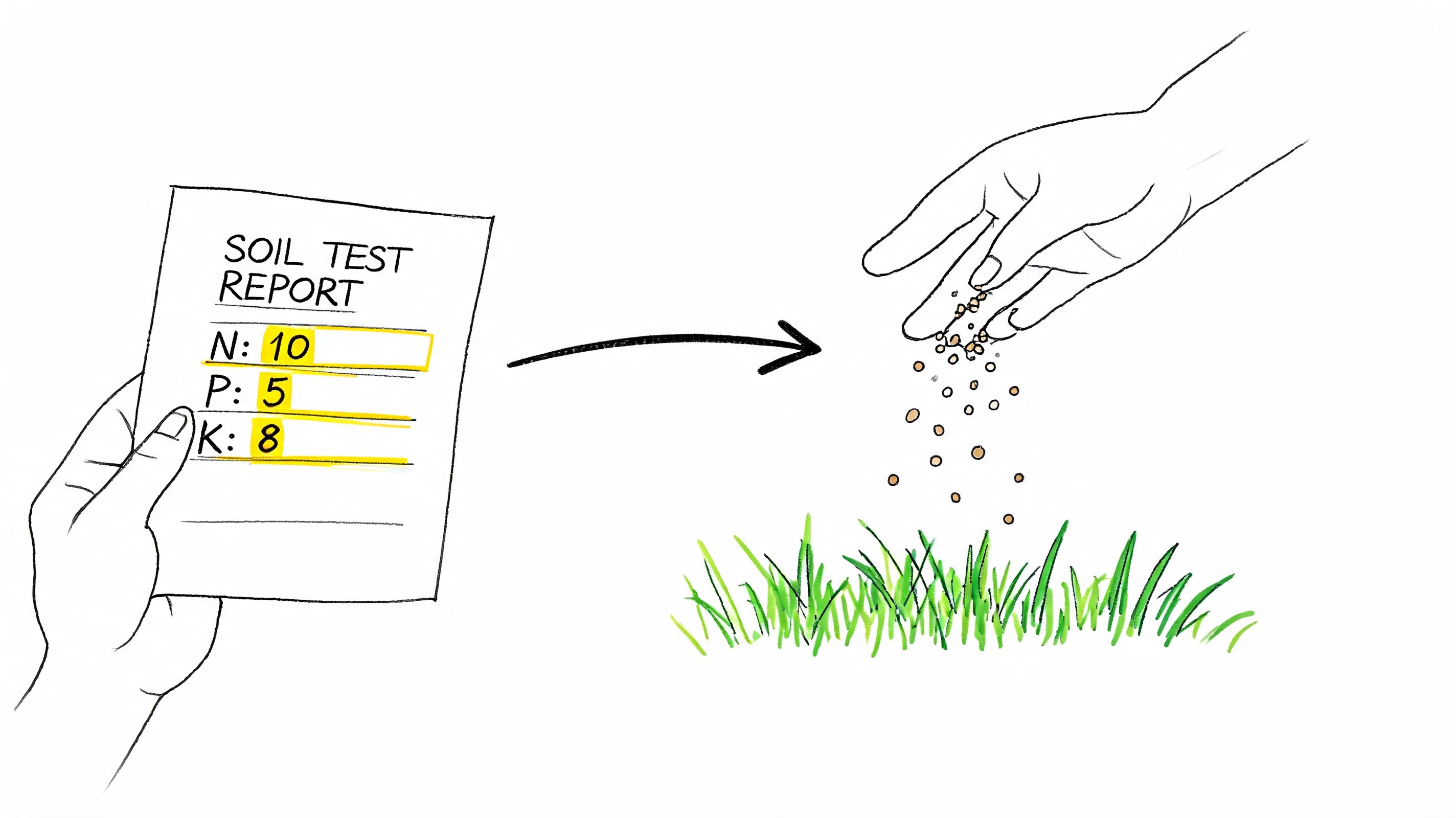
Start with what the lab report is really saying
Summer fertilization should be selective. If you don't have a soil test, you're guessing. If you do have one, the goal is to turn those numbers into a short list of actions.
For cool-season lawns, avoid nitrogen applications above 0.8 pounds per 1,000 square feet in summer, and skip summer nitrogen entirely if temperatures are consistently above 85°F, based on summer fertilization guidance summarized here. That same source notes that 65% of homeowners over-fertilize in summer, and that overdoing it can triple the risk of diseases such as necrotic ring spot.
That's why the right question isn't “What fertilizer should I buy?” It's “What does my soil need right now, and what should I avoid?”
When you read a lawn soil test for summer, focus on these points first:
- Nitrogen need: In summer, this is usually light and cautious for cool-season lawns.
- Phosphorus level: If phosphorus is already sufficient, don't keep applying more.
- Potassium level: Potassium often matters more than homeowners expect in summer because it supports stress tolerance.
- pH: Soil pH affects what the lawn uses.
- Organic matter: Helps explain how quickly the soil dries and how forgiving it will be in heat.
A simple summer decision table
Use this as a practical filter:
| If your soil test shows | What to do in summer | What to avoid |
|---|---|---|
| Lawn is heat-stressed or dormant | Skip feeding | Any nitrogen-heavy application |
| Nitrogen is needed and lawn is actively growing | Use a light, slow-release nitrogen rate, staying under 0.8 lb N per 1,000 sq ft | Quick heavy feeding |
| Phosphorus is already sufficient | Choose a product with no added phosphorus | Starter-style products by habit |
| Potassium is low | Correct potassium carefully based on the soil test | Random balanced fertilizer if P is already fine |
| Soil is dry | Water first, then feed in a cool window if feeding is still needed | Spreading fertilizer onto thirsty turf |
Summer fertilizer should solve a deficiency, not satisfy a habit.
One more point matters here. If your lawn is dormant, brown from drought, or barely growing, don't try to force it out of stress with fertilizer. Wait for better growing conditions.
A real example using soil test numbers
Here's a practical example using real thresholds from the guidance above.
If your lawn is a cool-season lawn, and you plan a summer nitrogen application, keep the rate below 0.8 pounds of nitrogen per 1,000 square feet. If your weather is consistently above 85°F, skip that nitrogen application and wait for a cooler window.
Now look at phosphorus and potassium. If your test says phosphorus is sufficient, don't choose a fertilizer that adds more phosphorus. If potassium is the weak point, use a potassium-focused product without added phosphorus, then water it in after application.
A simple summer plan might look like this:
- Check the soil test. Confirm whether nitrogen is needed and whether phosphorus is already sufficient.
- Check the lawn condition. If it's wilted, gray-green, or dormant, hold off.
- Water first if the lawn is dry.
- Apply during a cool morning window.
- Water granular fertilizer in right after application.
If you still need a soil test before making those decisions, start with a reliable sample and lab process. This guide on where to get your soil tested walks through that step.
The best summer feeding plans are usually modest. Light rate. Right nutrient. Correct timing. Watered in properly. That's how you help the lawn without pushing it past what summer conditions can support.
Create Your Precise Plan with MySoilPlan
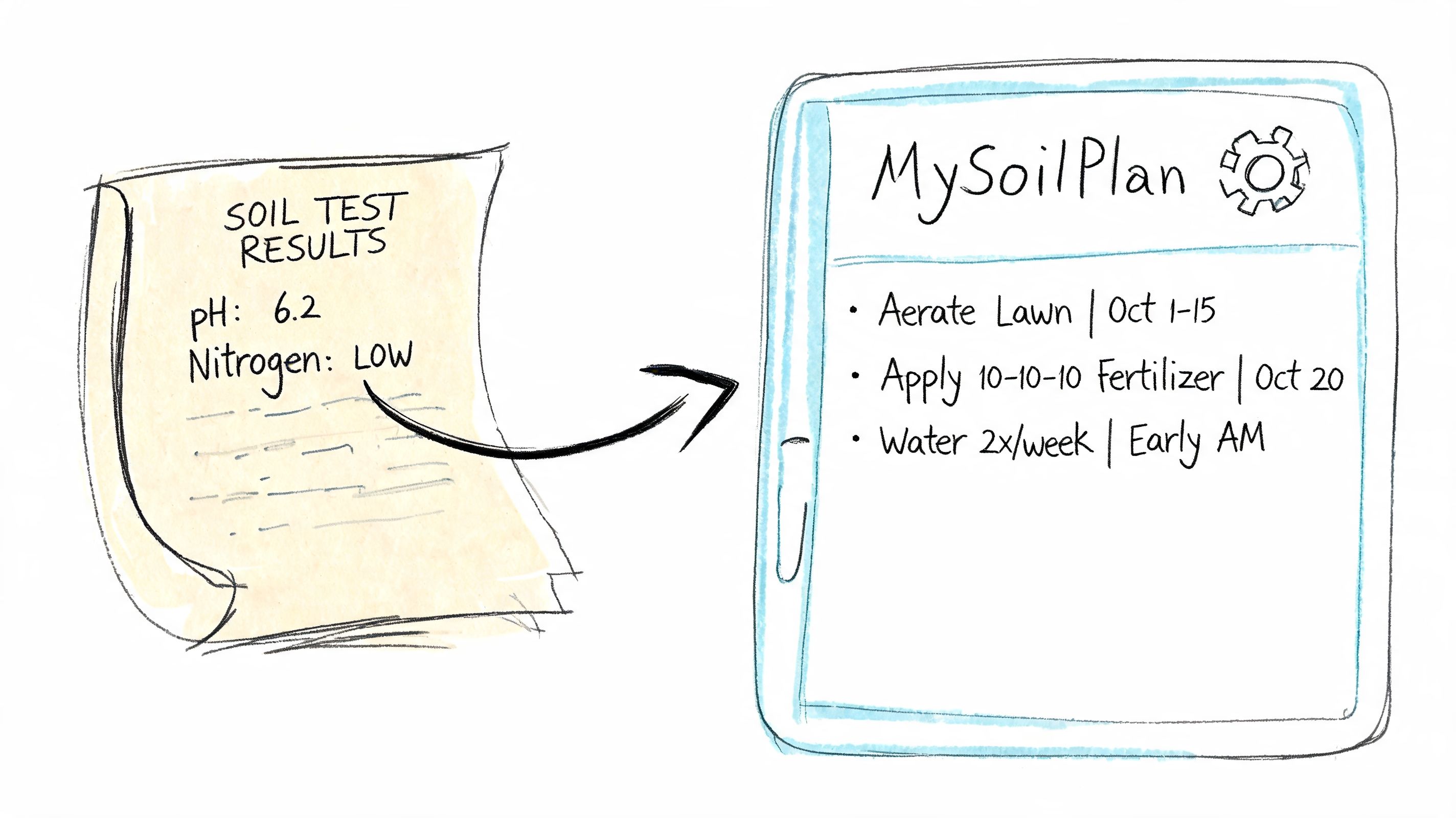
From lab report to calendar
Most homeowners don't struggle because they lack effort. They struggle because a soil report gives them numbers, while the lawn needs a schedule.
That gap gets bigger in summer. Generic advice says to mow high, water thoroughly, and be careful with fertilizer. All true. But it still leaves a homeowner staring at pH, phosphorus, potassium, organic matter, and square footage, wondering what to apply and when.
That's where a planning tool can help. MySoilPlan takes soil test inputs like pH, nitrogen, phosphorus, potassium, organic matter, CEC, and lawn size, then turns them into a season-by-season fertilizer schedule with measured application guidance. In summer, that matters because generic programs often ignore how your specific soil changes the recommendation.
What a useful summer plan should do
One overlooked issue is pH. If soil pH is above 7.5, phosphorus and micronutrient uptake can drop by 30% to 50%, which is one reason generic fertilizer advice often leads to waste or turf burn, as explained in this summer lawn care article.
A useful summer plan should do a few things clearly:
- Flag nutrients that are already sufficient: That prevents applying phosphorus just because it's in a common bag.
- Pace applications across the season: Smaller, better-timed doses are safer than one aggressive push.
- Adapt to the product analysis: The recommendation should change based on what fertilizer you choose.
- Show when to hold back: Sometimes the right recommendation is no summer feeding at all.
Here's the difference in plain terms:
| Generic approach | Data-based approach |
|---|---|
| Buy a common fertilizer and hope it fits | Match product choice to the soil test |
| Feed on the calendar only | Feed only if the lawn and soil both support it |
| Add phosphorus by default | Skip phosphorus when the soil doesn't need it |
| Ignore pH and OM | Use pH and OM to judge nutrient access and summer stress |
That's what turns a confusing report into a usable lawn care summer plan. The homeowner stops guessing and starts following a calendar that matches the lawn they have.
How to Handle Summer Diseases and Pests
Summer disease control usually starts too late. The brown patch gets the attention, but the trigger was often already in place for days. Long leaf wetness, repeated evening irrigation, excess nitrogen on a stressed lawn, and weak root systems all raise the odds that disease or insect damage will spread.
A soil test helps narrow the cause faster than guesswork. If potassium is low, turf typically handles heat and traffic poorly. If organic matter is low, the soil dries fast, roots stay shallow, and the lawn swings between drought stress and frequent watering. If pH is out of range, the grass may already be growing thin, which gives both disease and insects an easier target. That is why I do not separate pest prevention from soil numbers. They are tied together.
Treat the cause behind the symptom
Before applying anything, look at the pattern and compare it with how that part of the lawn grows.
- Spots that stay damp into the morning: Reduce irrigation frequency, water earlier, and check for sprinkler overlap.
- Matted turf with poor air movement: Raise the mowing height if appropriate for the grass type, and avoid adding more nitrogen during hot, humid stretches.
- Damage that showed up after a feeding: Soft flushes of growth are more vulnerable in summer, especially if the lawn did not need that application based on the soil test.
- One isolated patch: Spot-treat only the active area and a small margin around it instead of covering the whole lawn.
Fixing the site condition first usually does more than the product does.
A better summer check
Walk the lawn early in the morning while symptoms are still visible. Then match what you see to the likely stress point.
- Is the leaf blade wet every morning in the same area?
- Did that zone get fertilizer recently, especially nitrogen?
- Does the soil test show low potassium or a pH issue that may be weakening the turf?
- Is the grass thinning in compacted or poorly drained soil?
- Can the sod be pulled up easily, or are insects actively feeding?
That short check changes the response. A lawn with low potassium and thin summer growth may need a correction in the plan, not a blanket fungicide. A lawn with chronic overnight moisture often needs irrigation timing fixed before any treatment will hold. A lawn that lifts at the roots needs a targeted pest treatment where the damage is active.
MySoilPlan is useful here because it turns those soil values into a schedule you can use in summer. If the report suggests holding fertilizer, that can lower disease pressure. If it shows a nutrient shortage that affects stress tolerance, you can correct it in measured doses instead of forcing top growth in July.
Restraint gets better results in summer. Diagnose the pattern, use the soil test to explain why that area is struggling, and treat only what needs treatment.