Potassium Fertilizer for Lawns: A Complete Guide
You send off a soil sample, open the report, and see a potassium number that doesn't mean much on its own. Then you look at fertilizer bags and find more numbers, more letters, and no clear answer about what to do next.
That's where most homeowners get stuck. Potassium matters, but it's rarely obvious how low is too low, whether you even need more, or how to turn a lab result into a real spreader setting.
This guide walks through that process in plain language. You'll learn what potassium does, how to read the K result on your soil test, how to choose a potassium fertilizer for lawns, and how to calculate a rate you can easily apply.
Table of Contents
- What Potassium Does for Your Lawn's Health
- How to Read Potassium on Your Soil Test
- Choosing the Right Potassium Fertilizer Source
- How to Calculate Your Fertilizer Application Rate
- When and How to Apply Potassium for Best Results
- Putting It All Together Your Lawn's Potassium Plan
What Potassium Does for Your Lawn's Health
A lot of people think potassium is just the “last number” on the bag. In reality, it's what helps grass handle stress. I like to describe it as your lawn's stamina nutrient.
Potassium helps grass manage water, stay firm under pressure, and recover from wear. It doesn't make up for bad mowing or poor watering, but it helps turf hold itself together when conditions get tough. If you want a broader lawn feeding strategy, this guide on the best way to fertilize a lawn helps connect potassium to the rest of the plan.

Why potassium matters more than people think
In plant tissue, potassium is a major nutrient. It typically makes up 1.0-2.5% of plant tissue dry weight and supports osmoregulation, enzyme activation, and stomatal function, which all tie back to water balance and turgor in turfgrass according to Penn State turfgrass fertilization guidance.
That sounds technical, but the practical takeaway is simple. Grass with enough potassium usually handles heat, dry spells, traffic, and seasonal stress better than grass that's short on it.
Potassium is more like stress insurance than a rescue treatment.
What deficiency can look like in a real lawn
Low potassium is sneaky. Homeowners usually don't see one dramatic symptom and instantly know that potassium is the issue.
You're more likely to notice patterns like these:
- Faster wilting: the lawn dulls out or folds sooner between waterings
- Slow recovery: footprints, mower tracks, or traffic marks hang around longer
- Weak fill-in: the lawn stays thin even when growth seems otherwise decent
- Stress sensitivity: heat, drought, cold, or disease hits this lawn harder than nearby lawns
- Leaf edge yellowing or scorch: older leaves may show browning along the margins
None of those signs prove a potassium problem by themselves. They're clues, not a diagnosis.
Practical rule: If a lawn looks tired, weak, or slow to recover, use those symptoms as a reason to test the soil, not as a reason to blindly add potassium.
That's an important mindset for potassium fertilizer for lawns. Sometimes the lawn needs more K. Sometimes the soil already has enough, and the actual problem is watering, compaction, mowing stress, or another nutrient.
How to Read Potassium on Your Soil Test
You open your soil report and see a line for K with a number beside it. Then the second guessing starts. Is that number low, fine, or too high? And how does that lab result turn into an actual fertilizer plan instead of guesswork?
Start with the unit. On many lawn soil reports, potassium appears as K measured in ppm, or parts per million. For practical lawn care, ppm is the lab's way of showing how much potassium is available in the soil. If you still need a report to work from, this guide on where to get your soil tested walks you through the options.
Start with the number, then add context
A soil test number works like a fuel gauge. It gives you a reading, but the reading only becomes useful when you know the target range.
For many lawn soil tests, a potassium level under about 75 to 100 ppm is commonly treated as low, especially on Mehlich-3 reports. A reading in that area usually means the lawn has less reserve for drought, wear, and seasonal stress. The exact cutoff can vary by lab, which is why the interpretation notes on your report matter almost as much as the number itself.
Here is a simple homeowner reading of the range:
- Below 75 ppm: low enough that a potassium correction is usually reasonable
- 75 to 100 ppm: borderline. Check the lab note, soil type, and how the lawn has been performing
- 100 to 150 ppm: often an adequate working range for home lawns
- Above 150 ppm: usually a reason to pause, not to add more
That last point trips people up. A higher number does not mean your lawn will keep getting tougher if you keep feeding potassium.
Why the same K number can feel confusing
Two homeowners can both read “90 ppm” and make different choices. One has sandy soil that dries fast and a lawn that struggles in summer. The other has heavier soil and no stress history. Same number, different context.
That is why product-aware tools such as MySoilPlan do more than label a result as low or high. They translate the soil test into a rate, match that rate to the fertilizer analysis on the bag, and place it on a calendar. The soil test is the starting point. The plan comes from combining that number with your lawn's conditions and the product you intend to use.
Watch for “enough already” levels
Potassium shortages get most of the attention, but excess matters too. If K is already sufficient, repeated use of high-potassium “stress” fertilizers can push the soil out of balance.
That matters because potassium interacts with other nutrients, especially calcium and magnesium. In plain terms, piling on more K can make it harder for the grass to use what is already in the soil well. The lawn may still look off, and the natural reaction is often to add even more fertilizer, which misses the actual problem.
A soil test should answer one question first: does this lawn need more potassium at all?
A practical way to read your result like a plan builder
Use this order every time you look at the potassium line:
- Find the K value and unit. Usually that is potassium shown in ppm.
- Check the lab extraction and interpretation notes. Those notes tell you how that lab classifies low, medium, or high.
- Place the number into a working bucket. Low, borderline, adequate, or high.
- Compare it to the rest of the report. Calcium, magnesium, pH, and CEC help explain whether the number is a simple shortage or part of a bigger soil balance issue.
- Translate the shortage into pounds of K₂O per 1,000 square feet. That is the step that turns a lab result into a bag rate and seasonal schedule.
That last step is the one many articles skip. Homeowners often know their number, but they still do not know what to spread. A good plan closes that gap by converting the test result into a product-specific application rate instead of leaving you with a vague note to “apply potash.”
If your potassium is low, that is useful information. If it is already in a good range, that is useful too. Either way, the goal is the same. Read the number correctly, then make the next decision from the report instead of from the fertilizer bag.
Choosing the Right Potassium Fertilizer Source
You have a low potassium result in front of you, and now you are standing in the fertilizer aisle looking at bags with numbers like 0-0-50 and 13-0-44. This is the point where a clear soil test plan matters, because the right product depends on what your lawn needs, and what it does not.
Start with one simple rule. Match the product to the shortage on the report.
If potassium is low but phosphorus is already in a good range, a potassium-only fertilizer usually makes the cleanest correction. That keeps you from adding nutrients just because they happen to be bundled in the bag. MySoilPlan follows that same logic when it turns a soil test into a product-aware recommendation. It looks at the nutrient gap first, then matches that gap to a real fertilizer analysis you can buy.
What the bag numbers actually tell you
Fertilizer labels use the N-P-K system. The third number is the potassium portion, shown as K₂O on the label.
So a bag marked 0-0-50 supplies potassium without nitrogen or phosphorus. A bag marked 0-0-60 does the same thing, but in a more concentrated form. A bag marked 13-0-44 adds potassium and nitrogen together.
That difference matters more than many homeowners expect. Picking fertilizer is a lot like buying paint for one wall. If one wall needs color, you do not repaint the whole room by default. In the same way, if your soil test shows a potassium gap and your phosphorus is already fine, a potassium-only source usually fits the job better than a balanced blend.
If you need a refresher on how fertilizer percentages turn into actual product amounts, the math works much like a lime application rate calculator for lawn amendments, where you convert a recommendation into a spread rate based on the material analysis.
Common potassium fertilizer sources compared
Here are the main products homeowners run into most often:
| Source Name | Typical Analysis (N-P-K) | Best For | Things to Watch For |
|---|---|---|---|
| Potassium sulfate | 0-0-50 | A strong general choice when you need potassium without phosphorus | Lower potassium concentration than 0-0-60 |
| Potassium chloride | 0-0-60 | A concentrated, often lower-cost source of potassium | Chloride can be a poor fit for stressed lawns or repeated heavy applications |
| Potassium nitrate | 13-0-44 | Cases where the lawn also needs readily available nitrogen | Adds nitrogen whether you want it or not |
| Langbeinite-type products | around 0-0-22 | Situations where magnesium and sulfur may also help | Less direct if potassium is the only shortage |
The easiest way to sort these is to ask two questions.
Does the lawn need only potassium, or potassium plus something else?
If the answer is only potassium, start by looking at potassium sulfate or potassium chloride.
Is the lawn already stressed by heat, drought, or poor rooting?
If yes, many homeowners prefer potassium sulfate because it supplies potassium without the extra chloride load.
A practical default for homeowners
For many lawns, potassium sulfate is the safest starting point. It gives you a straightforward potassium correction and avoids adding phosphorus. It also avoids the extra chloride that can make product choice less forgiving on a stressed lawn.
Potassium chloride can still be useful. It is more concentrated, which means fewer pounds of product for the same K₂O target. But concentration is not the only factor that matters. A good plan looks at the lawn's condition, not just the cheapest bag on the pallet.
Potassium nitrate makes sense only when your plan calls for both potassium and nitrogen at the same time. If your nitrogen program is already set, this product can throw off the schedule.
Langbeinite-type products can help when potassium is low and the report also points to magnesium or sulfur needs. If your only problem is low potassium, they are usually a less direct fix.
Buy for the soil test in your hand. Then choose the product that fits that need with the fewest extras.
How to Calculate Your Fertilizer Application Rate
You have the soil test. You bought the bag. Now you need to turn those two pieces into a rate you can put in the spreader.
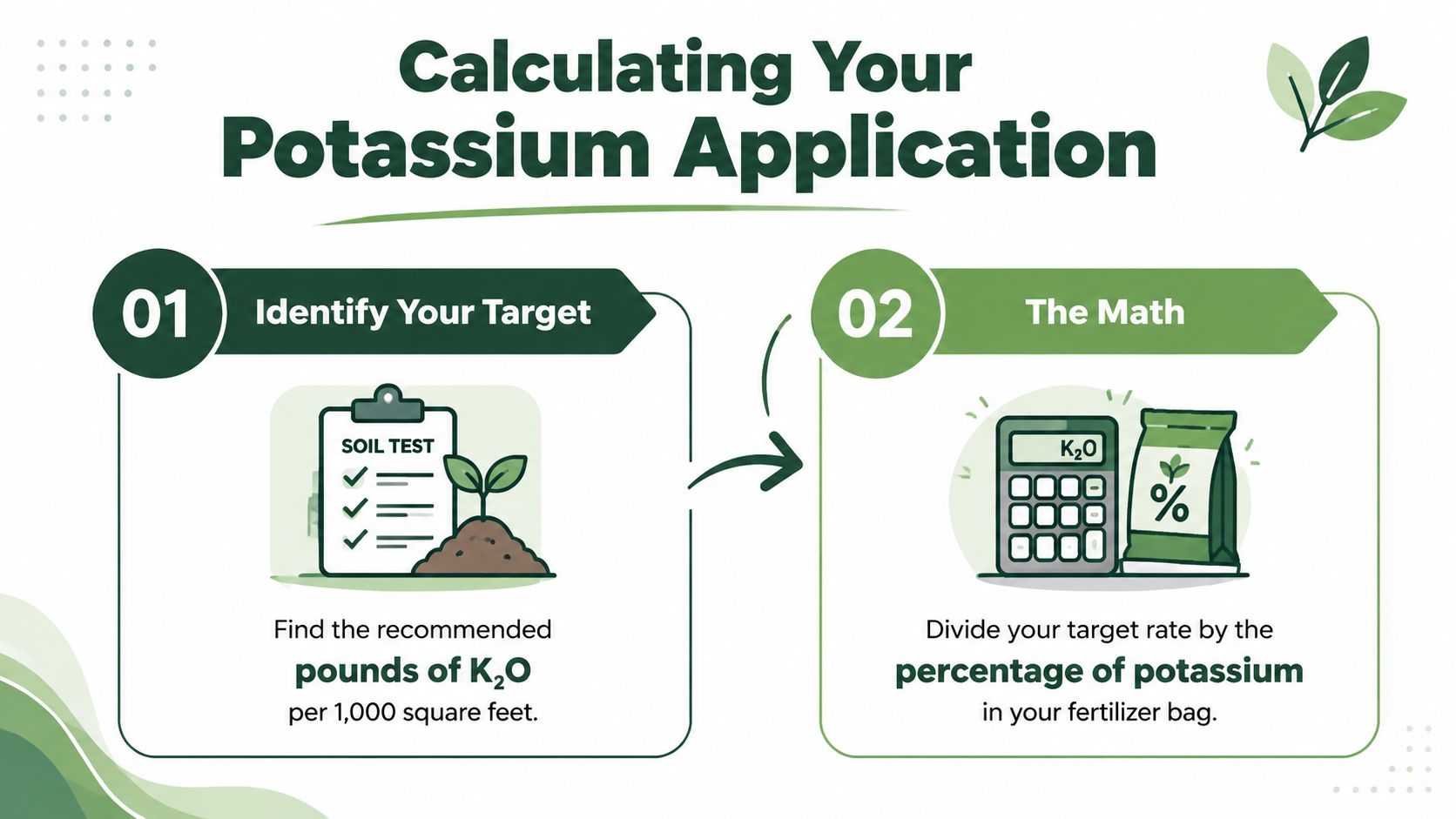
This is the part that trips up many homeowners, because the soil test recommendation and the fertilizer label are speaking slightly different languages. Soil tests usually tell you how much potassium your lawn needs as K₂O per 1,000 square feet. Fertilizer bags also list potassium as K₂O, but only as a percentage of the product.
Once you see that, the math gets much easier. It works the same way as other amendment calculations, including a lime application rate calculator for converting a recommendation into pounds of product.
The simple formula
Use this formula:
Recommended K₂O rate ÷ product K₂O percentage as a decimal = pounds of fertilizer product per 1,000 sq ft
A bag labeled 0-0-50 contains 50% K₂O, or 0.50 in decimal form.
So if your soil test calls for 1 lb of K₂O per 1,000 sq ft, the calculation is:
1 ÷ 0.50 = 2
That means you need 2 pounds of product per 1,000 sq ft.
A good way to picture it is to treat the bag like a concentrate. A 0-0-50 product gives you half a pound of K₂O in each pound of fertilizer, so you need 2 pounds of product to deliver 1 pound of K₂O.
Worked example for a real lawn
Let's walk through it the same way a product-aware plan would.
Your soil test recommendation says:
- 1 lb K₂O per 1,000 sq ft
Your fertilizer bag says:
- 0-0-50 potassium sulfate
Step 1: Convert the bag number to a decimal.
- 50% = 0.50
Step 2: Divide the target by the percentage.
- 1 ÷ 0.50 = 2 lbs of product per 1,000 sq ft
Step 3: Scale it to your lawn size.
If your lawn is 5,000 sq ft, you have five units of 1,000 sq ft.
- 2 lbs × 5 = 10 lbs of product total
So the full application is 10 pounds of 0-0-50 spread across 5,000 square feet.
| Soil test target | Product | Rate per 1,000 sq ft | Total for 5,000 sq ft |
|---|---|---|---|
| 1 lb K₂O | 0-0-50 | 2 lbs product | 10 lbs product |
How a precise plan handles this
This is the same logic a tool like MySoilPlan uses. It starts with the soil test target, reads the nutrient analysis on the bag, converts the percentage to a decimal, and then scales the result to your lawn area.
That process matters because different potassium products can deliver the same nutrient target at very different product weights. If one bag is more concentrated than another, your spreader setting and total pounds applied will change, even though the soil goal stays the same.
Two mistakes to avoid
Do not calculate from the product name alone.
Calculate from the K₂O percentage on the label.
Do not stop at the per-1,000 number.
Multiply it by your actual lawn size so you know how many total pounds to buy and apply.
Those two checks turn a confusing label into a clear application plan.
When and How to Apply Potassium for Best Results
Timing matters almost as much as the rate. Potassium should go down when the lawn is actively growing and able to take it up.
If the turf is dormant, badly drought-stressed, or baking in extreme heat, forcing a correction usually isn't the smartest move. Wait until the grass is growing and can respond.
Best timing for most lawns
For most lawns, the safest windows are spring and fall, when growth is active and temperatures are more forgiving.
A simple rhythm looks like this:
- Spring: apply when the lawn is actively growing
- Early fall: a strong window for follow-up if more potassium is needed
- Avoid peak stress: hold off during severe heat, drought stress, or dormancy
Watering matters too. Potassium products can burn leaves if they sit on the blade, especially in dry weather, so they should be watered in after application.
When to split the dose
Some soils can't hold potassium well. Sandy soils are the biggest example.
On sandy soils with CEC below 5, potassium leaching risk is high, so the annual amount should be split into 2-3 smaller applications, such as 0.5 lb K₂O per 1,000 sq ft each, applied in spring and fall rather than all at once, as noted earlier in the soil test guidance section.
That split approach is useful because it does two things:
- It reduces waste
- It lowers the chance of overloading the root zone in one shot
Application checklist
If you're applying potassium fertilizer for lawns yourself, keep the technique simple and consistent:
- Apply to dry grass: dry blades help granules fall through the canopy better
- Use a calibrated spreader: even distribution matters more than speed
- Water it in: move the product into the soil after application
- Use smaller doses on sandy soil: that's safer and usually more effective
- Don't force a correction during heat stress: let the lawn recover first
A smaller, well-timed potassium application usually beats one heavy pass at the wrong time.
For many homeowners, that's the difference between a clean correction and a frustrating one.
Putting It All Together Your Lawn's Potassium Plan
You get your soil test back, see a potassium number, and then hit the central question: what do you do with it?
A good potassium plan works like a simple recipe. Start with the test result. Match it to the right fertilizer source. Convert the nutrient need into a real product amount. Then place those applications in the part of the season when the lawn can use them.
A practical decision path
For a homeowner, the cleanest way to make sense of the report is to walk through it in order:
-
Start with the potassium level
- Low means you need a correction plan.
- Sufficient means you may not need any potassium now.
- High means the smart move is usually to wait and avoid adding more.
-
Look at the rest of the soil test
- If phosphorus is already in range, choose a potassium product that does not add phosphorus.
- If your soil is sandy or has low CEC, plan on smaller doses instead of one heavy application.
-
Choose the fertilizer source
- Potassium sulfate is often a practical choice for lawns because it supplies potassium without adding chloride.
- Other sources can still fit, but they should match both the soil conditions and the season.
-
Calculate the product rate
- Use the K₂O percentage on the bag label, not guesswork.
- Divide your K₂O target by the fertilizer's K₂O percentage written as a decimal.
-
Build the schedule
- Put applications into active growth periods.
- Split the yearly amount if the soil is more likely to lose potassium between treatments.
That sequence is close to how a planning tool such as MySoilPlan turns a confusing lab report into an actual lawn plan. It uses the same inputs a homeowner sees on the page, like potassium level, pH, CEC, lawn size, and product analysis, then converts them into a schedule with product amounts and timing.
That matters because a potassium plan is not just about fixing a low number. It is also about avoiding unnecessary applications. If the soil already has enough K, adding more can create imbalance with other nutrients and waste money.
A simple rule helps here. Treat potassium like a measured correction, not a routine habit.
If you want a quick mental model, read the soil test like a set of instructions from left to right. The potassium number tells you whether action is needed. The fertilizer label tells you how much product supplies that need. The season tells you when the lawn is ready to take it up. Once those three pieces line up, the plan gets much easier.
Keep the final takeaway simple: apply potassium only when the soil test supports it, choose a source that fits the rest of the report, and set the rate from the label. That is how confusing numbers turn into a clear, product-aware application plan.